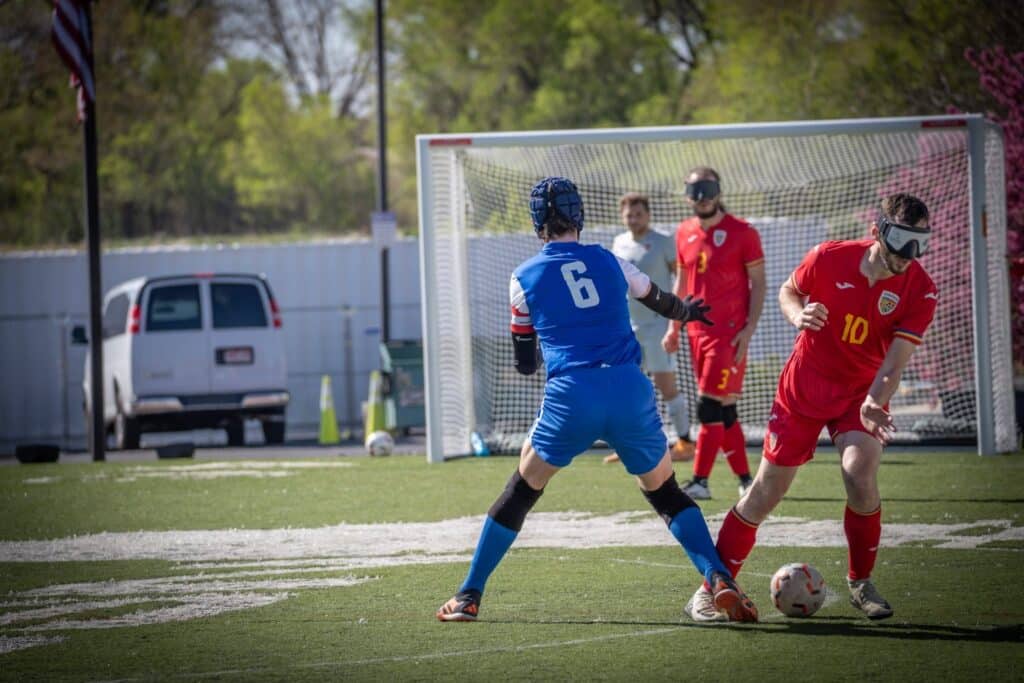
NOD’s Vice President, Corporate & Government Relations Charles-Edouard Catherine shares insights on his journey in finding community and confidence rooted in disability culture.
There is a specific, comfortable rhythm that happens when I meet another disabled person. It’s an unspoken frequency, a little voice in the background that whispers, “I’ve been there.” It isn’t just about shared symptoms; it’s a shared language of the soul.
For generations, society viewed disability through a clinical lens. If you couldn’t be cured or “corrected,” you were relegated to invalidism—not just physically, but socially. I grew up in the shadow of that model. I thought my disability was an embarrassment, a secret to be kept in the dark. My only role models were my brother and a few distant icons like Ray Charles or Stevie Wonder. In casual conversation, people didn’t ask about my dreams; they asked if there was a “cure” or “hope” for my children.
I spent years trying to perform continuous, cheerful, striving. I wanted to be “normal.” I refused to use a cane, avoided the pool, and stayed home at night rather than admit I couldn’t see. I believed that to be worthy of respect, I had to “overcome” my disability. I was exhausting myself trying to become the one thing I fundamentally was not: non-disabled. As my vision continued to fade, it became impossible to hide, and I realized that the obstacles in my path weren’t just my eyes, it was the deep-seated prejudice of a world not built for me.
I am a child of the Americans with Disabilities Act (ADA). I grew up with the promise of equal access, yet the reality remains stark: disabled individuals are still twice as likely to be unemployed, universal design is the exception, not the rule. I began to push back against the values I had internalized. I realized that for most of us, prejudice is a far greater barrier than impairment.
The late historian Paul Longmore once noted that the disability movement has two phases. The first is the quest for rights and access. The second—the one we are living in now—is the quest for collective identity; this is the birth of Disability Culture.
I found my way into this culture through adaptive sports. For the first time, I met people with disabilities who represented success and joy. I stopped seeking mere “inclusion” in a non-disabled world and started seeking self-definition within my own community.
Today, as the captain of the Men’s Blind Soccer National Team, my disability isn’t something I “overcome,” it is the framework through which I excel. Sports saved my mental health. It provided a platform to show that with simple accommodations, we don’t just participate; we thrive. The Paralympics shouldn’t be an afterthought; they shouldn’t be a post-script. They should be a celebration of a distinct, vibrant culture.
Disability culture can be interpreted in many ways, but in my experience, it is anchored by four key values: the strength of self-empowerment, the sanctuary of community, the courage to challenge preconceived notions, and an unapologetic sense of pride.
This culture wasn’t passed down to me by my parents or teachers. It wasn’t in my school books. It was gifted to me by my peers. It took me decades to realize that I didn’t need to be “cured” to be valid. It is a lifelong journey, but I’m no longer alone.
###
About the National Organization on Disability (NOD)
The National Organization on Disability (NOD) is committed to increasing employment opportunities and fostering inclusive work environments for the millions of Americans with disabilities. NOD offers a suite of employment solutions tailored to anticipate and meet leading companies’ workforce needs and has helped some of the world’s most recognized brands be more competitive in today’s global economy by building or enriching their disability inclusion programs.
For more information about NOD, visit www.nod.org.