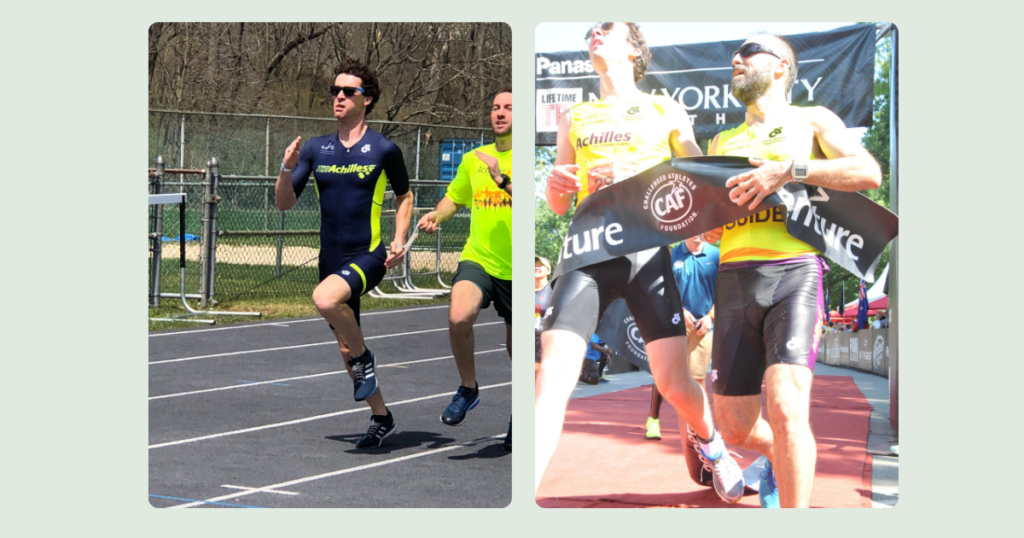
Charles-Edouard Catherine, Vice President of Corporate & Government Relations at NOD, reflects on how a simple running bib helped him embrace disability culture, and how asking for accommodations can unlock confidence, community, and opportunity at work.
For a long time, there was a specific item in my closet that I treated like a heavy weight. It’s a simple running bib. It doesn’t have a race number or a flashy sponsor logo; one word printed in bold letters: BLIND.
When I first started running, I hated that bib. I didn’t want it in my life, and I certainly didn’t want it on my back. To me, it felt like a neon sign broadcasting a vulnerability I wasn’t ready to own. I wanted to be “just another runner,” blending into the rhythm of the pavement without any labels.
But over time, my perspective shifted. I realized that the bib wasn’t a mark of weakness, it was a tool for safety and freedom.
Whether it’s a physical bib, or a digital accommodation in an office, we often resist the things that identify our needs. Why? Because asking for help (or even just signaling that we navigate the world differently) can feel like we’re losing our independence.
We worry that if we speak up, people will see the disability before they see the person. But in reality, by staying silent we actually limit our potential. We spend so much energy “masking” or overcompensating that we have less energy left for the actual task at hand. Not to mention that we miss out on tools that can make our lives easier.
This struggle isn’t limited to running, it shows up every Monday morning in the workplace.
Asking for accommodations—whether it’s screen-reading software, flexible scheduling, or specialized hardware—can be incredibly tough. It’s a conversation that requires vulnerability. It’s the “bib” of the professional world. However, just like that running bib keeps me safe from other runners I cannot not see, workplace accommodations level the playing field. They aren’t “handouts” or “cheats;” they are a boost to make our talents more impactful and productive.
If you’re struggling with the idea of asking for what you need, remember these three things:
- Clarity is Kindness: When I wear my bib, I’m giving the people around me the information they need to interact with me safely. In the office, being clear about your needs helps your team support you effectively.
- Energy Conservation: When you stop fighting against your environment and start using the tools designed for you, you unlock a new level of productivity and ease.
- Normalizing the Conversation: Every time one of us speaks up about an accommodation, we make it easier for the next person to do the same.
The bib that I once wanted out of my life is now the first thing I grab before I head out the door. It represents my right to be in that space, running my own race, on my own terms. If there’s an accommodation you’ve been hesitant to claim—at work or in your personal life—give yourself permission to wear it. It’s not a sign that you’re falling behind; it’s the very thing that allows you to keep moving forward.
###
About the National Organization on Disability (NOD)
The National Organization on Disability (NOD) is committed to increasing employment opportunities and fostering inclusive work environments for the millions of Americans with disabilities. NOD offers a suite of employment solutions tailored to anticipate and meet leading companies’ workforce needs and has helped some of the world’s most recognized brands be more competitive in today’s global economy by building or enriching their disability inclusion programs.
For more information about NOD, visit www.nod.org.